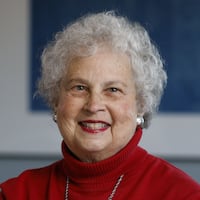
VIDEO: To hear executive director Mary Campbell Zopf talk about thte Muse Machine, see MyDaytonDailyNews.com
A SUNDAY CHAT
In her series of Sunday Chats, arts writer Meredith Moss visits with folks in our area who are making news in the arts.
If you know of someone who should be featured, contact Meredith: MMoss@coxohio.com
Please leave a daytime phone number.
A SUNDAY CHAT
In her series of Sunday Chats, arts writer Meredith Moss visits with folks in our area who are making news in the arts.
If you know of someone who should be featured, contact Meredith: MMoss@coxohio.com
Please leave a daytime phone number.
A SUNDAY CHAT
In her series of Sunday Chats, arts writer Meredith Moss visits with folks in our area who are making news in the arts.
If you know of someone who should be featured, contact Meredith: MMoss@coxohio.com
Please leave a daytime phone number.
A SUNDAY CHAT
In her series of Sunday Chats, arts writer Meredith Moss visits with folks in our area who are making news in the arts.
If you know of someone who should be featured, contact Meredith: MMoss@coxohio.com
Please leave a daytime phone number.
At the recent Mid-Day Arts Cafe at the Schuster Center, the lunchtime audience was inspired by the words of the Muse Machine’s new executive director, Mary Campbell Zoph.
Before introducing the energetic group of talented students who will be performing in the organization’s upcoming production of “Oliver!” at the Victoria Theatre, (Jan. 15-18), Zoph talked about her own love for the arts and the importance of introducing the arts to young people.
“I actually have no memories of my life without the arts!” said Zoph, who grew up in Springfield and most recently served as education director and deputy director of the Ohio Arts Council in Columbus. She has lived in Yellow Springs since 1975.
Zoph began her career in Dayton — first as a Dayton Public School visual arts teacher and later at the Dayton Art Institute, where she oversaw a wide range of public programs.
“My life’s story is as a maker, a learner, an appreciator and a supporter of the arts,” she told the crowd at the Schuster. “I have always believed that the arts are an enduring human story that belongs to all of us. As humans we cannot help but create the story of the arts through our traditions, experience and religious practices.”
In 1988 when Zopf left Dayton for the OAC, she says she took an important lesson with her: that artistic collaboration was key to truly great work, relevant work and strong partnerships.
“I truly hoped that one day I would get back to Dayton,” she says. Now, 26 years later, she has returned.
Q. What is your earliest memory of an arts experience?
A. I grew up surrounded by the arts. My mother loved the arts — we listened to opera and classical music — we were surrounded by art books — actually books of all kinds, and by the age of 4, I was taking art lessons at the YWCA and later lessons at the Springfield Museum of Art in Cliff Park.
One of my earliest and most powerful memories was going to hear the Springfield Symphony as a first grader. I still remember walking into Memorial Hall — the space seemed huge, when the concert began the lights dimmed and the orchestra seemed to glow, and I could feel the music in my body. I have carried that memory with me all my life. I like to remind people that it is important to never underestimate the power of one early arts experience.
Q. What are your favorite types of arts experiences?
A. I love all the arts but I am particularly drawn to the visual arts, poetry, theater, contemporary dance and film-making. And I am very interested in unique juxtapositions of traditional forms that heighten our experience in new ways or just surprise us — such as bringing hip hop together with opera, or creating and integrating film and video into fields such as theatre, dance and opera.
Q. Tell us about the Ohio Arts Council and what it does?
A. It was created in 1965 by Governor James A. Rhodes to foster and encourage the development of the arts in communities throughout Ohio so that all citizens had equitable access to the arts whether they live in a rural area, small town or big city.
Funding from the Ohio Arts Council and the National Endowment for the Arts has made this possible and allowed the benefits for the arts to be realized by not just a few communities or individuals but by many. Today, the OAC’s budget for fiscal years 2014-15 is $22,698,408. Each year approximately 630 grants are awarded to artists, schools and organizations producing or presenting arts programming.
During my last three years with the agency, we received the second-largest grant for state arts agencies in the country, exceeded by only California.
Q.What has drawn you to Muse Machine over the years?
A. It was easy to stay in touch with the Muse Machine through my OAC work as education director and deputy director. Across Ohio, Muse was recognized many times as one of our state's best arts education organizations, and it has certainly endured while other wonderful arts education organizations did not.
All of these arts education organizations did great work. But they have not endured for a variety of reasons. What Muse has done so very well, is that it has had great stewards for decades, its mission is compelling, and the Muse story is about transformation.
The best part of being new at Muse is that almost everyone I meet says: “Muse Machine changed my life! Let me tell you my story.” These transformations occurred because Suzy Bassani, the organization’s founder, and many others believed that young people deserved access to extraordinary artistic experiences of the highest quality. Suzy understood that young people and their teachers would not only respond to quality but that their lives would be forever changed by the artistic experiences they had. When an arts experience is deeply meaningful and satisfying, people want more.
Q. Most people know about the big Muse Machine productions each year but what else does Muse do?
A. We also provide arts-integrated, curriculum-based programming for students in grades K-12, discounted tickets for secondary students who attend performances of our arts partners downtown, theatre road trips, performing arts workshops and unique arts experiences and training for teachers.
Q. How does Muse pick its annual big show?
A. It may come as a surprise, but selecting a musical each year is a complicated business. First, our Director of Youth Programs, Doug Merk, works with his creative team to select titles. Then the hardest part of the nine-month process begins — determining whether the appropriate set exists in the country, the performance rights are available, it suits our upcoming talent in a general way, etc.
Q. How does arts education affect students in the long run?
A. Recent National Endowment for the Arts research revealed that arts education in childhood is the most significant predictor of both arts attendance and personal arts creation throughout the rest of a person's life. Today, we have a strong research base on all the ways the arts strengthen literacy development, academic success and cognitive and social development.
Q. How has Muse Machine changed over the years?
A. Clearly the Muse mission and work has endured, but life in Dayton is very different today than it was in 1982. Very few arts organizations came through the Great Recession unchanged.
Muse is a much smaller organization today than before the recession, just like most arts organizations. We have strong financials. Our mission still inspires. Our students continue to amaze us and our teachers work just as hard, if not harder, to open the doors to the arts to their students across 10 counties in and around the Dayton region. How we work with our teachers is foundational to all that we do at Muse and we want our teachers to have learning experiences just as rich and varied as our students.
Q. What’s your vision for the future of the organization?
A. Over the last five months, Muse staff have been engaged in in-depth conversations with our teachers and students to learn more about their perspectives and hopes for the organization and to capture their stories of learning and transformation. We are also creating a detailed picture of the schools they work in and better understand how we might help them in their educational work and to opening the doors to the arts for their students.
When Muse gets it right — like last year’s summer concert — people walk out of the Victoria and feel a sense of delight, they feel joy, they feel more connected to one another. I remember walking outside the Victoria and a person near me saying, “I feel hope for our future.” I felt the same way.
Q. How do you communicate the value of the arts to the general community?
A. I like to walk people back through their arts experiences — as makers and as audience members so they can notice the details of those experiences and savor them again. I also like to connect that personal experience to our community experience, and what that means in one's civic life. The impact of the arts is greatly amplified when we bring those two things together.
Muse Machine was borne out of the belief that the power and the promise of the arts is for everyone, and it is one of the greatest gifts we can give our children. If we unlock the power of imagination in them — no matter where their lives take them or what work they are involved in — they will use that gift to look beyond what is. Thriving in the global economy requires the ability to see relationships between disciplines — the arts, science, technology and the humanities. A strong background in the arts helps students develop the necessary skills for becoming the innovators, problem solvers and collaborators the world needs.
About the Author