Still, Schneider likes that he’s in full control of the process. With his own darkroom and an enlarger to print his negatives at home in Greenville, he leaves his photos at the mercy of the developer — whether they turn out or not. In a time when speed defines photojournalism, Schneider has built something around slowing it down.
He often uses Kodak Tri-X, an inexpensive, versatile black-and-white film stock. He sometimes springs for Kodak T-MAX, a finer grain stock that mimics the old Life magazine photographs, the original reason he was drawn to film.
Growing up in Greenville, Schneider would often go antiquing with his dad. In the shops, he’d flip through piles and piles of Life.
“Absolutely killer photos, and then the text, it was just butter,” Schneider said. “And I was like, How do I do something like that?”
There were two Life features in particular that had a profound effect on his photography. One was called “The End of a Company Town,” from March 1971, which documented the economic devastation of Saltville, Virginia. after the town faced the closure of its chemical plant. The second was Larry Burrows’ “One Ride with Yankee Papa 13,” a cover story with a door gunner in Vietnam, standing over his two dead comrades.
“Photographs are incredibly powerful,” Schneider said. “I want to be able to capture that.”
When a Greenville car dealership that had been around since the 1930s was closing, Schneider conceptually delivered his own version of “The End of a Company Town.” He used the original spread as a direct reference for his own photography.
He currently has five film cameras: a Leica, two Nikons, a Canon FTb, and a Mamiya/Sekor that was carried in Vietnam. He also does event photography for Darke County Parks with his digital camera, a Nikon Zf.
He began shooting film in 2016, went professional in 2021, and by 2023 was fully developing his own work. Though film is a choice for Schneider — he prefers the deep grain of black and white — for many of his influences, it was their only option.
“I like the idea that 20, 30, 40 years from now, pulling out binders of negatives from this time would be a pretty incredible thing,” Schneider said. “That legacy aspect is a big draw for me.”

Credit: Jake Schneider
Credit: Jake Schneider
In August 2024, Schneider started shooting an ongoing project called “Doors at 8, Music at 9,” in which he captures the Dayton music scene on proper stages and in underground and basement venues. He deepened the project in early 2025 and plans to conclude it later this year.
“It’s kind of like capturing that human side of people,” he said. “What I’m planning right now is to have a handful of concert photos, right? But I want most of them to be of the people that make the community a community. Whether that be the performers themselves or the promoters or even the people that show up to all the shows. I feel like that’s under-documented, photo-wise.”
It’s the audience, or what the bands are like in the green rooms — the difference between a metal band on stage versus off — those intimate moments that Schneider gravitates toward. At Relentless Fest at the Brightside, there was a mosh pit for kids, adjacent to the mosh pit for adults. These are some of the reasons he consistently keeps a camera around his neck.
He says taking a photo is just as memorable as the photos themselves. On his Instagram, where he posts a majority of his portfolio, Schneider details what camera, lens, and film stock he used for each photo. With film’s finite exposures, the relationship the photographer has to the details of the shots is embedded into the moments, just as a digital camera logs that info automatically.

When Riley Weisman, aka Man Dies., deejayed a full 24 hours at Belmont Billiards, Schneider took photos. In front of the deck, temporarily obscuring the live stream, Schneider stood there with his lens aimed at Weisman, his flash autonomous from the camera, held in his other hand, waiting to press the shutter. He shot blind — one frame — and somehow aligned the antlers on the wall to make them look like they came out of Weisman’s head.
It was a moment in time — one exposure on a roll — that he waited to grab, and he grabbed it. But not every photograph stays light forever.
Schneider had a photo pass for Ohio Dreamfest in Ansonia. A person in one of the photos he took died later that year. The photo was then discovered by his friends.
“I took those photos and it brought those people happiness to see him in a happier environment,” Schneider said. “He’s smiling, he was listening to music. I want to capture those moments and document and keep them forever.”
But perhaps the photographer’s greatest gift of all is his simultaneous fly-on-the-wall status and his valued eye of the local music scene.
Credit: Jake Schneider
Credit: Jake Schneider
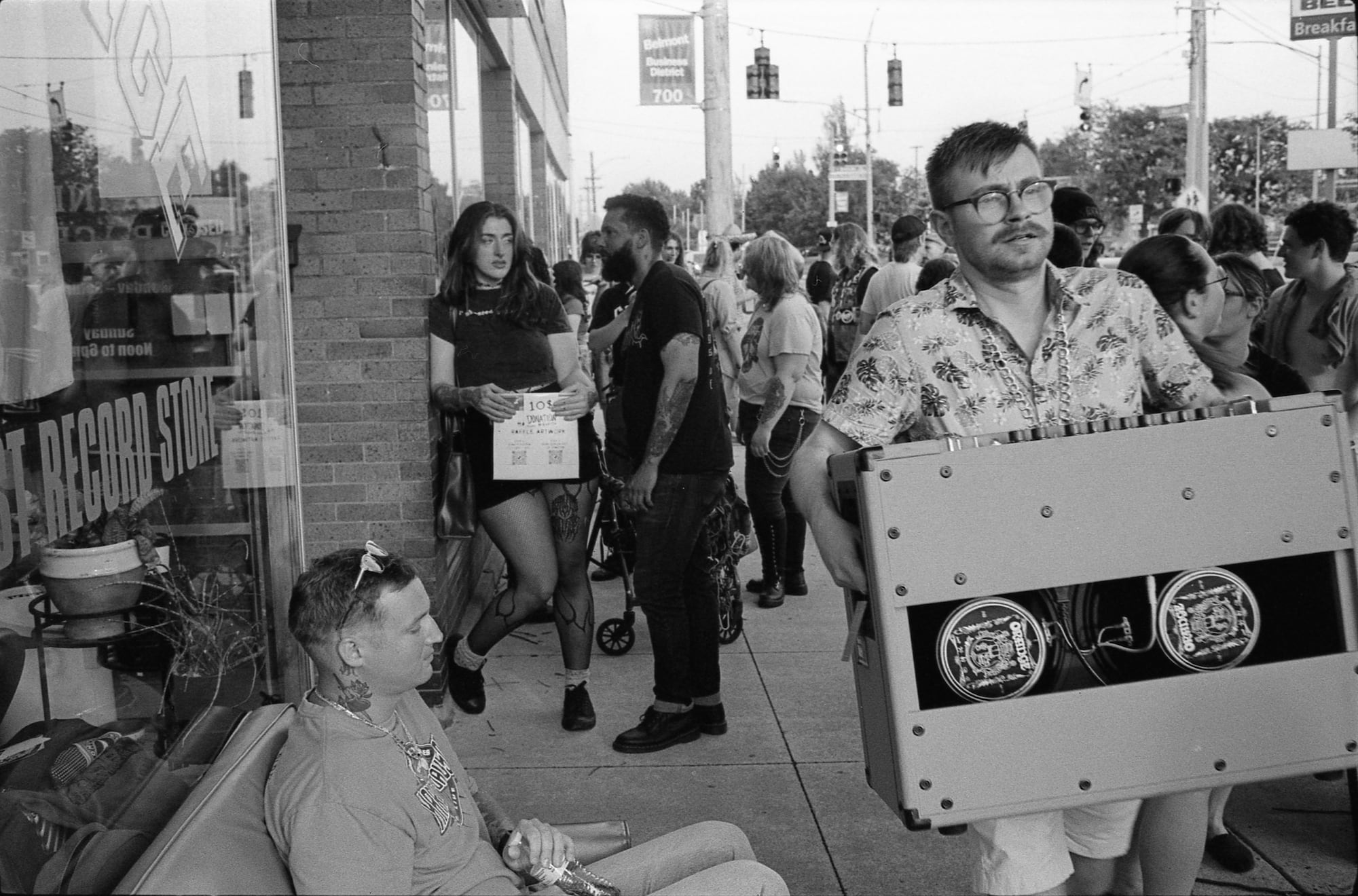
At Blind Rage Records’s final in-store show at the Belmont location, on what was perhaps the hottest day of 2025, Schneider snapped a photo of the sidewalk scene. In the foreground, Sheller guitarist Corey Dixon hauled an amp at changeover. To his right, the sidewalk couch, outside to make room for the surplus of sweaty folks indoors. In the background, microcosms of conversations spilled onto the sidewalk.
One shutter on a Leica. A Voigtlander 35mm at f/1.4. Schneider captured something human.
Brandon Berry covers the music and arts scene in Dayton and Southwest Ohio. Reach him at branberry100@gmail.com.
HOW TO GO
What: Fast Art: 40+ artists & live DJs
When: 7 p.m. Feb. 28
Where: Yellow Cab Tavern, 700 E. 4th St., Dayton
Cost: $5
More info: Jake Schneider’s work can be found on Instagram and Medium.
About the Author