Down memory lane
Alex Heckman is vice president of museum operations for the 65-acre open air museum and is the co-author of a new 222-page book entitled “A Living Landmark: The Story of Carillon Historical Park.” Written with Steve Lucht and designed by Nancy Chifala, the walk down memory lane contains more than 400 photos.
“Steve and I thought we knew the park inside out but there were many more interesting stories we uncovered in writing the book,” said Heckman who loved history as a child and remembers coming to the park when he was in the first grade. “My favorite exhibit is Wright Hall which houses the 1905 Wright Flyer III. It’s our most significant artifact and it provides a tangible link to Dayton’s most famous story.”
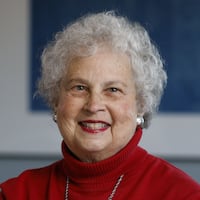
When Mary Mathews took over as the first on-site executive director for the park in 1985, it had been operating strictly on endowments.
“There was just a place where you drove in and paid but we needed an orientation center, a central place for guests,” said Mathews who served through 2003. “We had our first fundraising event and built what’s now the Kettering Family Education Center. We also updated Wright Hall and added a wing. We covered the trains that had been out in the open and we opened the print shop, one of my favorite places.”

One of Mathews’ proudest moments occurred when she hired a 15 year-old by the name of Brady Kress who had learned blacksmithing and wanted to demonstrate his skills at the park. She went to his parents, filled out papers and got special permission for him to work.
Today that little boy is the president and CEO of Dayton History. He’s been at the helm for the past 22 years and is credited with the tremendous growth of the park we’ve seen over the past two decades.
“He’s added buildings, enhanced others, enlarged the stories, trained the guides and hires people who love the place just like he does,” said Mathews. “He could be at (Colonial) Williamsburg but he’s not interested. Lots of national places would love to hire Brady away, but he loves Dayton.”

Credit: Dayton History at Carillon Histo
Credit: Dayton History at Carillon Histo
Kress can remember listening to music on the Carillon bells while floating in a canoe at NCR’s Old River park at age 6 and visiting the park with his mother and aunt.
“I remember it being one of those places you could run around at your leisure and look in the different exhibits. It was summer and I remember going in the covered bridge because it was cool there. And running up and down the steps to the Barney and Smith car that used to be outside.”

Credit: Dayton History at Carillon Histo
Credit: Dayton History at Carillon Histo
Kress said he’s proud of facilitating the merger between the park and the Montgomery County Historical Society to form Dayton History. He’s proud that they were able to get the Kettering-Moraine Museum assets moved to the park.
“From a construction perspective, I’m proud of the Heritage Center of Manufacturing and Entrepreneurship. And one of the most significant changes is the big Gauge 3 train that allows us to take guests on a one-mile loop around the park.”

His special place at the park is the Wright Cycle Company.
“Because that’s where I first met my wife. We were both tour guides in our high school years.”
Valued volunteers
Jim Charters of Washington Twp. has been a stand-out volunteer at the park for 20 years. He not only serves as an interpreter at exhibits but has given more than 350 presentations about the Park and the history of Dayton for thousands of people across the Miami Valley.
“It’s given me the opportunity to meet people from all over the world,” said Charters, who also gives tours of Oakwood’s Hawthorne Hill, home of the Wright Brothers.

Marilyn Dickey of Beavercreek has been volunteering at the park for 12 years and is quite versatile. You may find her at Newcom Tavern, at the one-room schoolhouse, the Transportation building, the Wright Brothers complex and even on the train as conductor.
”We have this wonderful history of our town and to be able to share it and tell the story is great.”
Our readers remember
When Thomas Moon of West Carrollton was young, his mom would drop him off at Carillon Park when it opened and come back for him in the afternoon.
“Carillon did not have nearly so many exhibits as it does now but the one I loved most was the replica of Deeds Barn,” he said. " While I thought the 1912 Cadillac with the Delco self-starter was pretty neat, I was always mesmerized by the model of Col. Edward Deeds’ yacht, the ‘Lotosland.’ It was the most beautiful boat I think I’ve ever seen. I love the print shop, the automobile dealership and the transportation exhibit. Finally, the exhibit for McCall’s because many of the Newsweek magazines in the piles were proofed by my Dad, so it was a real treat to see all of them."
Jenni Phillips of Brookville wrote to say her first date with her husband was at Carillon Park when they were in high school.
“We walked around and looked especially at the National Cash Register building since his father worked for NCR at the time. We both enjoy history, so it was fun to appreciate the local history. Then we went and had a picnic lunch at the bells. Years later we took our daughter and her family there and got to enjoy it all over again through their eyes!”
After World War II, small homes were built for GIs near the University of Dayton Arena.
“Our home was on Smith Street, by the old Rike’s Warehouse which is now the Job Center,” said Bill Feldmann. “Being in the neighborhood and not having a lot of money, my dad used to take us kids to Carillon Park. I remember running up the hill and playing hide and seek around the base of the Carillon, then rolling down the hill. We’d repeat this until we were exhausted.” Feldmann now lives at the St. Leonard Retirement Community.
In 1996, when he was home from college, Ken Pavy mowed grass as part of the grounds crew.
“There were many fewer buildings back then. There was a caretaker who lived in the Grist Mill and in 1966, I was the only other employee. There was a small building in the parking lot that was staffed by a volunteer who collected admission fees and had a few information pamphlets about the park. During weekends and special events there were several volunteer docents stationed in the buildings.
“One afternoon in 1967. a school group arrived for a tour but there were no docents that day so I was asked to take the group around. An extra duty I remember most vividly was painting the floor of the Wright Flyer building. Now, 50 years later, we take our grandchildren several time a year.“
Pavey said especially likes the original buildings at the park that show what life was like in the beginnings of settlement and the growth of the area. His grandkids love the carousel, the train and the chicken tenders at Culp’s Cafe which they say are “as good as McDonald’s.”
“They visit the old school house almost every time at the park, and my 10 year old will sit there for the longest time, just absorbing the atmosphere, and will converse with the docent about how the students went about their day in school, carrying in firewood for the stove and so forth.”

Jackie Lawless remembers taking her four children to the bell concerts at the park in the 70s and watching them run up the hill and roll down.

The Faust family of Oakwood has had a membership to Carillon Park/Dayton History for over 30 years. When their sons were young, they enjoyed running around the grounds, checking out all the buildings and exhibits and getting their names printed on postcards at the print shop.

Credit: Picasa
Credit: Picasa
“They especially loved the trains,” said Sara Faust. “For our youngest son’s third birthday, he asked to have a train-themed party at the park and he still enjoys riding the miniature train to this day! And anytime visitors come to town, Carillon Park is on the top of the itinerary and the response is always the same: “This is so impressive! I didn’t know so many inventions and corporations come from Dayton. I want to come back next time; you can’t see it all in one visit.”
“We are thrilled to watch the park grow, visit each new structure and take in the latest exhibits that shine a light on the history and innovations of our Gem Cit,” Faust said. “ We can’t wait to see what the next 75 years bring!”
How to get the book
Copies of “A Living Landmark: The Story of Carillon Historical Park” by Alex Heckman and Steve Lucht, can be purchased at the Museum Store at the park for $35. It can also be ordered online. Go to shop.daytonhistory.org and search for the title, “A Living Landmark.”
HOW TO GO
What: Carillon Historical Park
Where: 1000 Carillon Blvd., Dayton
Hours: 9:30 a.m.-5 p.m. Monday through Saturday; Noon-5 p.m. on Sunday
Admission: $14 per adult (ages 18–59); $12 per senior and $10 per child (3-17) There is an additional charge of $1 for the Carousel of Dayton Innovation and a $5 charge for the train ride
Parking: Free
Info: daytonhistory.org; Watch Carillon Park’s 75th anniversary video: youtube.com/watch?v=l5Nw67XUHTs
CARILLON FACTS
- Founded by Col. Edward Deeds, designed by the Olmsted Brothers, sons of Central Park’s Frederick Law Olmsted
- Built in 1942 and is 65 acres along the Great Miami River
- Features the most Wright family artifacts in the world at its Wright Brothers National Museum, including the 1905 Wright Flyer III
- In 2005, the park merged with the Montgomery County Historical Society to form “Dayton History”
- Archive Center has millions of Dayton region’s artifacts
- Home to more than 30 historic structures
Source: DaytonHistory.org
NEW EXHIBIT
A new exhibit honoring the late James M. Cox, whose influential imprint of entrepreneurship and leadership encompassed journalism and politics, will open at Carillon Historical Park this year. Cox, who lived and died in Dayton, is also the founder of Cox Enterprises. The company’s roots date to 1898, when the 28-year-old, Ohio-born farm boy purchased the Dayton Evening News — now the Dayton Daily News — for $26,000.
About the Author