When he told a non-Jewish friend, Jennifer Marshall, his concerns, she told him she was going to order a Hanukkah menorah from Amazon and put it in her window to show solidarity for the Jewish community.

The ceremonial candelabra is traditionally lit by Jewish families throughout the world during Hanukkah. One extra candle is added every night to celebrate religious freedom and the survival of the Jewish people. This year, the holiday begins Sunday evening and runs through December 22.
Kulbersh, who was raised as a Reform Jew, said he has “a deep spiritual and cultural connection to Judaism” and wanted to make a difference by passing the idea along to others.
“Right now in America and around the world we are facing historical levels of antisemitic violence,” he said. “According to the Anti-Defamation League, we had the highest number of incidents of antisemitism in America last year in their 46 years of tracking. It’s terrifying. I thought this is a very simple way that someone can show their Jewish neighbors this house is a safe place. I just wanted to find a way to help allies speak up against hate, many for the first time.”
Getting started
Kulbersh began by googling “How do you start a website?” and then “How do you create an Instagram post?” He built his Project Menorah website and created a simple menorah printout that people could stick on their windows. He encouraged people to post on Instagram feeds and tag Project Menorah.
Within 10 days, thousands of people in all 50 states and in 16 countries on seven continents had responded, including a man in a boat on an iceberg in Antarctica!

The New York Times showed up on his doorstep on the first night of Hanukkah and Kulbersh was featured on “Good Morning America.” The woman who created the menorah stamp for the US Postal Service gave him an unlicensed version of the stamp to color in. The team that puts up the menorah at the White House saw what he was doing and tagged Project Menorah.
“It was everyday gentiles who knew that their Jewish community was suffering and wanted to help,” Kulbersh said. " It’s the holidays. It should be joyous. I realized despite what social media and the news tells us, the word is full of wonderful people who want to help."
What happened in Billings
Although Kulbersh had never heard of Billings, Montana, others began texting him about a heartwarming story similar to his own.
“It was an extraordinary situation,” Kulbersh said. “In 1993, a Jewish home was vandalized after the children put an arts-and-crafts menorah in their window. A brick went through a child’s bedroom window. The tiny community, which had a negligible Jewish population, rose up and said ‘not in our town.’ The newspaper printed a full page menorah illustration and 10,000 people tore it out of the paper and taped it onto home windows, store fronts and cars. They said ‘hate has no place here.’”
Kulbersh believes there are Jewish families around the world who are especially nervous about putting their menorahs in the window this year.
“I firmly believe that there are infinitely more good people than bad and sometimes people just don’t know how to help and I wanted to offer a simple way,” he said. “Every family of every faith background should feel safe to celebrate their holidays. This is a simple way to tell friends and neighbors that ‘Love Lives Here.’

Are you an upstander?
Kulbersh’s friend, Jennifer Marshall, is an good example of an upstander, someone who is not a bystander, but stands up for a person or group that is being attacked or bullied.
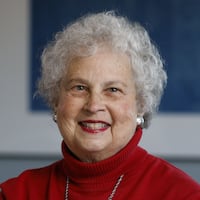
“Project Menorah, with all its moving pieces, exemplifies the true nature of an upstander action in that it involves acts of kindness directed toward someone who was hurting or vulnerable at the time,” said Bonnie Rice, who chairs the Upstander Project of Greater Dayton.
The program is organized by the Jewish Community Relations Council under the umbrella of the Jewish Federation of Greater Dayton.
Rice said those who are involved in the local project are diverse in race, gender, national origin, religion, sexual orientation and physical ability.
The group has collaborated with the Dayton Bar Association’s Social Justice Initiative, the Interfaith Forum of Greater Dayton, the University of Dayton School of Law, UD Human Rights Center and the Hall Hunger Initiative.
“Our activities have included attending a naturalization ceremony of new citizens; holding a forum on immigration enforcement, rights and responsibilities; a clothing drive; a dialogue on the personal impact of events in the Middle East and participating in a racial wealth gap exercise,” Rice said. “We are currently involved with planning a program/dialogue for 2026 on Black-Jewish Reconciliation.”
Rice said the Upstander Project in Dayton strives to build a sense of community by focusing on four foundational pillars: dialogue, education, community service and social engagement.

Actions born in kindness, she said, generate an affirmation of another’s worth and dignity, break the veil of isolation for the vulnerable party, draw on empathy over apathy and restore a collective sense of justice and caring to a community.
“Where silence or inaction allows the darkness to expand, an upstander action, like Project Menorah, sparks and intensifies the light.”
HOW TO GET INVOLVED
Those who are interested in learning more about Adam Kulbersh’s Project Menorah can go to projectmenorah.com, click on “get involved” and download a menorah printout to put in a window. In the Miami Valley, a wide range of menorahs can be purchased at synagogue gift shops.
“It’s a way to tell your neighbors you’re a safe space,” said Kulbersh. “If you are on social media, snap and post a picture, tag Project Menorah and we will share your photos with the world.”
To learn more about Dayton’s Upstander Project contact Jeff Blumer at 937-401-1558 or jblumer@jfgd.net.
About the Author