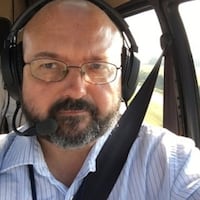

“I think this is going to make a good impact on our ability to save lives as a coordinated team,” Adam Murray, a Maryland state police trooper, flight paramedic and paramedic instructor, said in an interview. “The more information we can pass, the better.”
This is the first time medical care providers are using the Battlefield Assisted Trauma Distributed Observation Kit — what the Air Force calls “BATDOK” — to document the conditions of their civilian patients.
Maryland flight paramedic crews use the AFRL-developed tool as part of their standard toolset as they transport injured patients to hospitals for shock trauma treatment.
BATDOK is application smart phones or mobile devices designed to help medics monitor patients, complete documentation and support life-saving decisions in less than ideal conditions.

Credit: 354th Fighter Wing Public Affair
Credit: 354th Fighter Wing Public Affair
The idea is simple, but for medical crews on the move, useful: The app replaces pen and paper records — records tricky to use on turbulent flights or muddy battlefields.
“We are proud to deliver this technology to military and now civilian medics, helping to save lives on the battlefield and beyond,” said Brig. Gen. Robert Bogart, 711th Human Performance Wing commander. “This capability is a direct result of the powerful synergy between our engineers, operational users and medical professionals within the 711th Human Performance Wing.”
Word is starting to spread. Gregory Burnett, a lead engineer and product manager with the 711th Human Performance Wing at Wright-Patterson, said the Air Force is getting requests from multiple states for more information about BATDOK.
Murray said so far, BATDOK has worked well for him and his colleagues. It can automatically convey to a receiving trauma center a lot of information about incoming patients, streaming data about vitals and more.
“We are doing the first 10 to 15 to maybe 20 minutes of emergency care for these patients,” Murray said. “Our patient population is almost all trauma patients. These are very severely injured people that we’re taking care of. We’re trying to secure an airway, start blood transfusions, so all sorts of advanced stuff.”
Once a medical evacuation flight is airborne, it’s usually just two paramedics in the back of aircraft, he said. Sometimes, they have to try to communicate via radio, and those calls can become fragmented.
Automatically and instantly streaming information to hospitals who will receive these patients is a key capability.
“If we’re super busy, we’ve had times where we’ve had to ask pilots to call the hospitals for us,” Murray said. “All of our hands are tied trying to keep somebody alive.”
He has been able to use BATDOK to calculate how much of a patient’s body has been burned, for example.
BATDOK “was designed to be in those forward-contested environments,” Burnett said. “And it really was put together understanding the end-user.”
The tool has been in the spotlight before. In 2023, the military’s Joint Operational Medicine Information Systems picked BATDOK for use by all military branches as the joint integrated electronic health record for point-of-injury and care on the move.
About the Author